
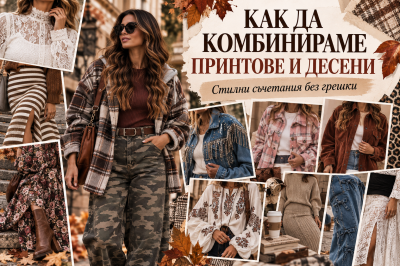
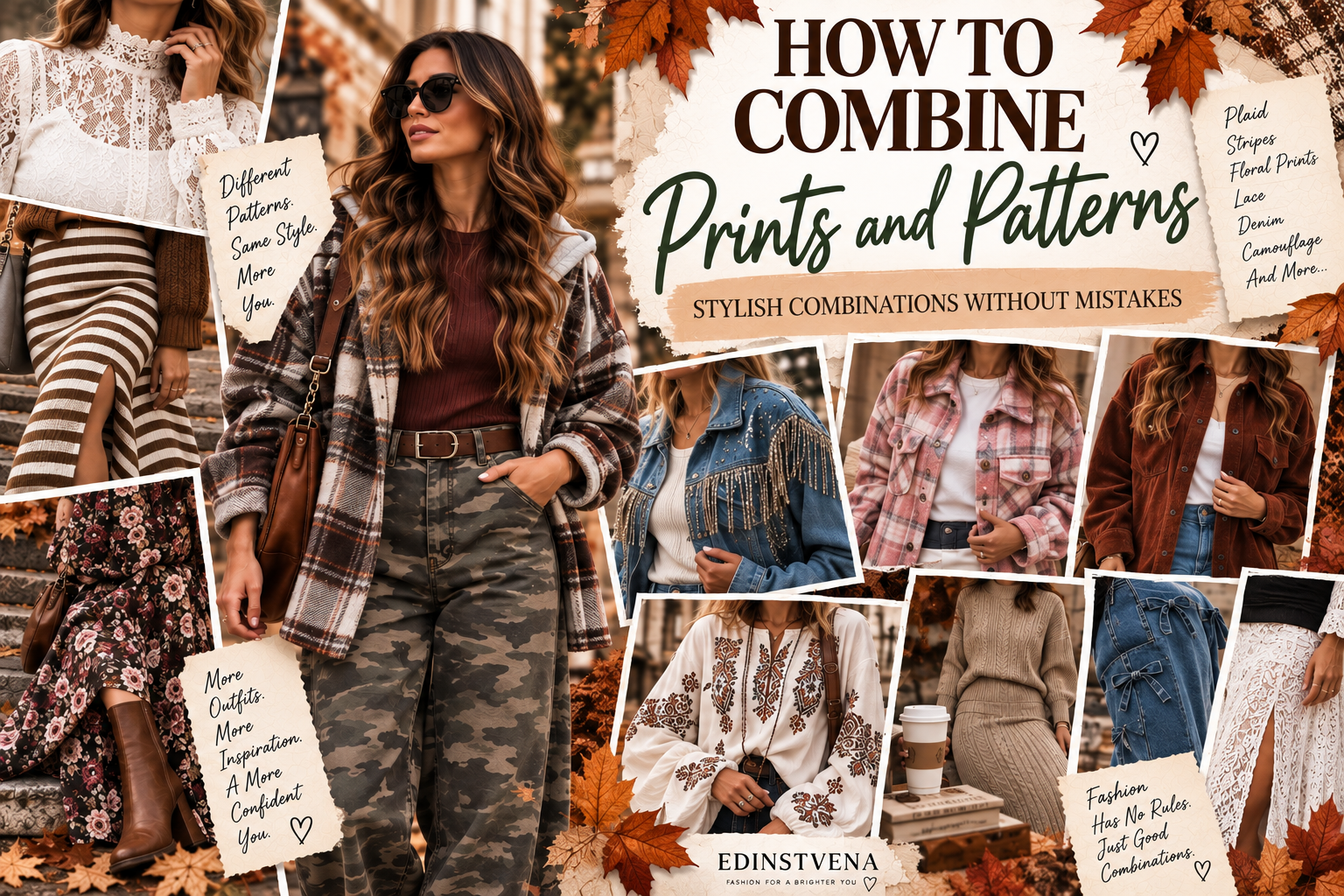
Combining prints and patterns in clothing can turn an ordinary outfit into something much more interesting and memorable. Plaid, stripes, floral motifs, lace, patchwork and even camouflage can look great together – as long as you know how to balance them.
Many women avoid different patterns because they are afraid that the outfit will look too busy. The truth is that you don't have to give up on prints. You simply need to give them the right role.
In this article, you will learn:
- how to combine different prints in one outfit;
- which patterns are easiest to pair;
- how to wear plaid, stripes and floral motifs;
- how to combine lace with everyday clothes;
- how to use denim as a balancing element;
- how to wear bolder prints without making the outfit look overwhelming.
The Basic Rule When Combining Patterns
One of the easiest rules is:
Let one print be the main accent, while the other elements balance it.
For example, if you are wearing camouflage-print trousers, you don't need your top, jacket and accessories to be patterned as well.
You can combine:
printed trousers + a simple blouse + denim jacket
or:
printed dress + neutral shoes + simple handbag.
This way, the print remains the focus of the outfit, while the other elements complement it.
Plaid – One of the Easiest Patterns to Style
Plaid is one of the most practical prints because it can look casual, cozy and stylish at the same time.
For example, the women's plaid shirt jacket with hood can become the main accent of an autumn outfit.
Combine it with:
- a white blouse;
- blue or black jeans;
- simple ankle boots;
- a small brown or black bag.
This is a classic formula that works perfectly for everyday wear.
Plaid also pairs beautifully with denim. For example, a plaid jacket + jeans creates an effortless autumn outfit that doesn't look overly styled.
White + Print: The Safest Combination
When you don't know what to pair with a particular print, white is almost always a good choice.
It visually "calms down" more colorful elements and allows the pattern to stand out.
For example, the white blouse with ethnic print can be paired with simple denim.
Here you can go for:
printed blouse + blue jeans + neutral shoes.
You get an outfit that is interesting without looking too busy.
White is especially useful when the print contains several different colors.
Lace + Denim – When Feminine Meets Everyday
Lace is often associated with more elegant and romantic outfits, but there is no reason to save it only for special occasions.
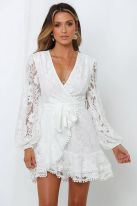
The white lace blouse with high collar is a great example of how a more feminine element can be incorporated into everyday style.
Combine it with:
- jeans;
- denim jacket;
- loafers or ankle boots;
- a simple handbag.
This makes lace look more modern and effortless.
The same rule works in the opposite direction – if you are wearing a more casual denim jacket, you can add a lace blouse or skirt to soften the outfit.
Light Pink Plaid + Neutral Colors
Plaid doesn't have to come only in traditional autumn colors.
Light pink plaid creates a softer and more feminine mood.
The light pink plaid shacket with patchwork can be the accent around which you build the entire outfit.
For a balanced look, combine it with:
- a white T-shirt;
- light or medium-wash denim;
- beige shoes;
- cream or brown accessories.
There is no need to add another strong print here. The plaid and patchwork details are already interesting enough.
Stripes + Brown – The Perfect Autumn Combination
Stripes are another print that is easy to combine with solid-colored clothing.
The long dress with brown and white striped pattern is a great example of an autumn combination in warm tones.
Brown and white create a natural base that you can complement with:
- brown ankle boots;
- a leather or suede bag;
- a beige jacket;
- gold-toned accessories.
There is no need for many colors here. The stripes already create enough visual interest.
Floral Prints Aren't Just for Spring
One of the most common mistakes is associating floral prints only with the warmer months.
A floral dress in deeper or neutral tones can be a wonderful part of your autumn wardrobe.
The midi dress with floral print can be worn with:
- ankle boots;
- a short jacket;
- denim jacket;
- knitted cardigan;
- a small bag in one of the colors from the print.
Here is one very useful trick:
Choose one color from the print itself and repeat it in another element of the outfit.
For example, if the dress has brown details, add a brown bag or shoes.
This creates a sense of cohesion.
When You Want a Complete Outfit – Choose a Set
Sometimes the easiest way to avoid a styling mistake is to choose a matching set.
The women's knitted sweater and skirt set already creates a visual connection between the separate pieces.
You can then keep the accessories simple.
For example:
knitted set + boots + small bag + minimalist jewelry.
This is a great formula for days when you want to look stylish without spending too much time deciding what goes with what.
Lace Skirt + Simple Top
A lace skirt can look very elegant, but also surprisingly modern if you combine it with an unexpected element.
The white women's lace skirt, for example, doesn't have to be worn only with an elegant blouse.
Try it with:
- a knitted sweater;
- denim jacket;
- shirt;
- more casual shoes.
This is an example of combining a feminine texture with an everyday element.
These kinds of contrasts often make an outfit more interesting.
Denim + Sequins + Fringe – Unexpected but Effective
Not all elements in an outfit need to belong to the same style.
The denim jacket with sequins and fringe in a western style is distinctive enough on its own.
That's why the rest of the outfit can be much more minimal.
For example:
statement jacket + white blouse + jeans + ankle boots.
This way, the sequins and fringe become the accent instead of competing with other strong elements.
Brown – The Perfect Partner for Autumn Patterns
Brown is one of the easiest colors to combine during autumn.
The women's shirt-style jacket in reddish brown can be combined with:
- cream;
- white;
- denim;
- beige;
- black;
- olive green.
This is a good example of why neutral and earthy tones are so practical – they allow you to add different prints without making the outfit look chaotic.
Camouflage Print – Let It Be the Star
Camouflage is a strong print. That's why the best approach is not to compete with it by adding lots of other patterns.
The women's camouflage-print jeans can be paired with a completely simple top.
For example:
camouflage denim + white T-shirt + black jacket + black shoes.
If you want a more feminine feel, you can add jewelry or a small structured bag.
And If You Want Something More Playful?
Then denim with a decorative detail can be a great choice.
The blue wide-leg jeans with bows already have plenty of character, so you can let them be the main accent.
Combine them with:
- a white blouse;
- cropped sweater;
- solid-colored top;
- simple jacket.
This way, the bows remain the interesting detail without competing with other prints.
How to Combine Two Different Prints?
This is where things get interesting.
If you want to combine two prints, use at least one of the following rules:
1. Let Them Have a Common Color
For example, two different patterns that both contain white.
This visually connects them.
2. Let One Be More Subtle
If one print is very bold, the second can be more delicate.
3. Combine Different Scales
A large floral print + smaller plaid often works better than two equally strong patterns.
4. Use a Solid-Colored Element Between Them
For example:
printed blouse + solid-colored trousers + patterned jacket.
This creates a visual "pause" between the two prints.
How to Combine Patterns According to the Occasion?
For Everyday Wear
Go for:
plaid + white + denim
or
printed blouse + jeans + simple jacket.
These combinations look modern while remaining easy to wear.
For Work
It's better to choose one main print.
For example:
stripes + brown + cream
or
floral dress + simple blazer + neutral shoes.
For an Evening Look
This is where you can add more texture.
For example:
lace + denim + metallic accessories
or
printed dress + solid-colored jacket + elegant shoes.
The Most Common Mistakes When Combining Prints
Too Many Patterns
If every piece of clothing has a different print, the eye has difficulty finding a focal point.
No Common Color
Two prints can be different, but if they have a common color, they are much more likely to look like part of the same outfit.
Too Many Accents
Plaid + floral + sequins + fringe + bright accessories can turn into an overly busy combination.
Forgetting About Textures
It's not only prints that matter. Lace, knitwear, denim, sequins and other materials also create visual interest.
Sometimes it's better to combine one print + one interesting texture instead of two or three different prints.
5 Easy Formulas You Can Always Try
1. Plaid + white + denim
A classic and easy autumn combination.
2. Floral + brown + denim
Feminine without being overly romantic.
3. Lace + denim + neutral accessory
A modern contrast between delicate and everyday.
4. Camouflage + white + black
A bolder look with a clear focal point.
5. Stripes + earthy tones + gold accessories
A warm and elegant combination for autumn.
Conclusion
Combining prints and patterns doesn't mean putting everything colorful and patterned on at once.
On the contrary – a stylish outfit often comes from the contrast between one interesting print and several calmer elements.
Plaid can be combined with denim.
Lace with everyday clothes.
Floral motifs with brown and beige.
Stripes with neutral colors.
Camouflage with clean, basic pieces.
And when you want to combine two different patterns, look for a common color, different scales or a neutral element between them.
The most important rule, however, is simple:
Don't be afraid of prints – just give them enough space to stand out.